Wednesday, 26 February 2014
Research Point - Still Life Brief History
First still life referenced in the writings from Hellenistic Greece but no examples have survived.
Earliest examples found in the ruins of Pompeii.
Middle Ages western art was heavily influenced by the Christian church and as such paintings were mainly of a religious nature.
Still life as we know it first appeared as decoration in the foreground of figurative paintings. Example of this is Pieter Aertsen's Vegetable Seller 1567
Still life as painting genre attributed to the Dutch artists, with influence from Italy, Jacopo de'Barbari's Still Life with Partridge, Iron Gloves and Bolt of a Crossbow 1504
Dutch scenes of the 17th Century of a laid table, feast like set-ups of game, fish, fruit and vegetables and ornate drinking vessels. Van Dijks Still Life with Cheese 1613. These paintings seem to be making a statement about the status and wealth of the person commissioning the art work
In the impressionist painters of the 19th century focused mainly on landscape but on occasion painted still lifes, Still life with melon, 1882.
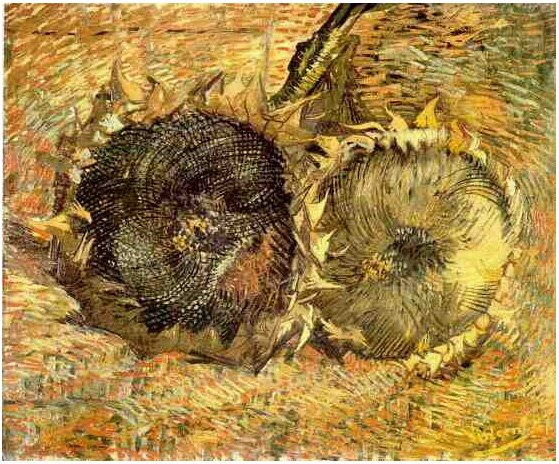
Two painters working around the same period of the impressionist movement that are well known for their still life paintings are Vincent Van Gogh and Paul Cezanne. Vincent did many studies of Sunflowers subject matter that he focused on during his struggle with his art work. In the same, but perhaps, more academic way Cezanne used still life, often including apples ,to improve his art simplifying form and developing painting techniques to emphasis surface planes, work consider to have influence on the Cubism.
My studies of two of Cezanne's watercolours
Still life with Apples, Bottle and Chair Back:
The Three Skulls:
Sunday, 23 February 2014
Research Point - Use of Colour
Here I have chosen two paintings, both painted in a non-naturalistic way but both having a very different end result. Both painted I would say in a period of post impressionism, Gauguin's painting style is expressionistic where Bonnard's is more about how the colours related, considering colour theory with his use of the yellow hues of the face and the violet in the coat, aiming for more aesthetic/pleasing composition. Gauguin's colour choice packs more of a punch yes he uses combination of the complementary colours green and red but the inclusion of the vivid orange and yellow gives of a unsettling vibe , enhanced by the sinister looking face and the addition of the halo.
Paul Gauguin - Self Portrait with Halo, 1889
My study of painting:
Pierre Bonnard - Self Portrait, 1889
This picture I like a lot, certainly one of my favourite portrait painting not only for it's colours but the manner in which is been painted, their is an unresolved quality to the painting but there is enough detail in eyes to indicate a look of concentration.
My study....
Exercise: From light to dark the watercolour way
Many times I have read or heard that tones with in a painting are more important than the colours, if the tonal composition is not successful then the painting can not be saved by the choice of colour.
In this exercise I am exploring tonal range by building up layers of the same watercolour mixture. I have two primary colours red and blue and two different brands of paynes grey.
In all four examples, shown below, it is clear that the tonal contrast between each wash diminishes as more washes are applied. In my examples, regardless of the colour used I struggle to distinguish easily more than five different tones.
Sunday, 16 February 2014
Exercise: Warm and cold colours
In this exercise we are exploring complementary colours, either warm or cold not sure I got my head around the concept of warm and cold colours. Simplistically I would state that red is a warm colour and blue is a cold colour, but then, when start to think of different blues as being warm or cold then I begin to struggle... cerulean blue colder than ultramarine blue?
The following quick watercolour studies (no longer than 5 minutes) were done from observation.
The next studies where imagined scenes
Emile Nolde is artist who work my tutor suggested I take a look at....
Emile Nolde (1867 - 1956) is considered one of the first Expressionist painters. He painted many vibrant watercolours, examples of which..
Sea with Violet Clouds and Three Yellow Sail Boats, 1946
Sunset over Blue Mountains, 1938
In 1942 Nolde wrote*:
There is silver blue, sky blue and thunder blue. Every colour holds within it a soul, which makes me happy or repels me, and which acts as a stimulus. To a person who has no art in him, colours are colours, tones tones...and that is all. All their consequences for the human spirit, which range between heaven to hell, just go unnoticed.
*quoted in Nolde-Forbidden Pictures (exhibition catalogue), Marlsborough Fine Art Ltd., London, 1970,p.9
Saturday, 8 February 2014
Exercise: Working with greys and browns
Still life exercise focusing on the monochrome, introducing a single patch of colour for contrast. Preferred still life (apples on stripped tea towel) produced in the previous exercise but this has more to do with the less contrived composition than the colour choices.
Compositional studies:
Colour studies:
Final painting:
Position of the patch of red possibly not best placed in the foreground...
Article in the Artist & Illustrators (February 2014) entitled Chinese watercolours which showed examples of the winner's work from the Shenzhen International Watercolour Show (http://www.shenzhenbiennial.com). I was reading this article at the time I started this exercise, was drawn to one of the pictures that one an excellence prize that in many ways met the brief of this exercise (replacing the toy with several patches cerulean blue, decoration on tea pot) Ren Hui, Flowers Thinking Language
Compositional studies:
Colour studies:
Final painting:
Position of the patch of red possibly not best placed in the foreground...
Article in the Artist & Illustrators (February 2014) entitled Chinese watercolours which showed examples of the winner's work from the Shenzhen International Watercolour Show (http://www.shenzhenbiennial.com). I was reading this article at the time I started this exercise, was drawn to one of the pictures that one an excellence prize that in many ways met the brief of this exercise (replacing the toy with several patches cerulean blue, decoration on tea pot) Ren Hui, Flowers Thinking Language
Sunday, 2 February 2014
Subscribe to:
Comments (Atom)